



2nd October 2026
What Should Retailers Check in a Wet Food Cat Feeder?
-
 author

A wet food cat feeder is not simply a dry-food hopper with a different label. Retail buyers need to verify meal storage, serving time, power-loss behavior, and food-contact cleaning. The sample should give staff an explanation they can repeat in a store.
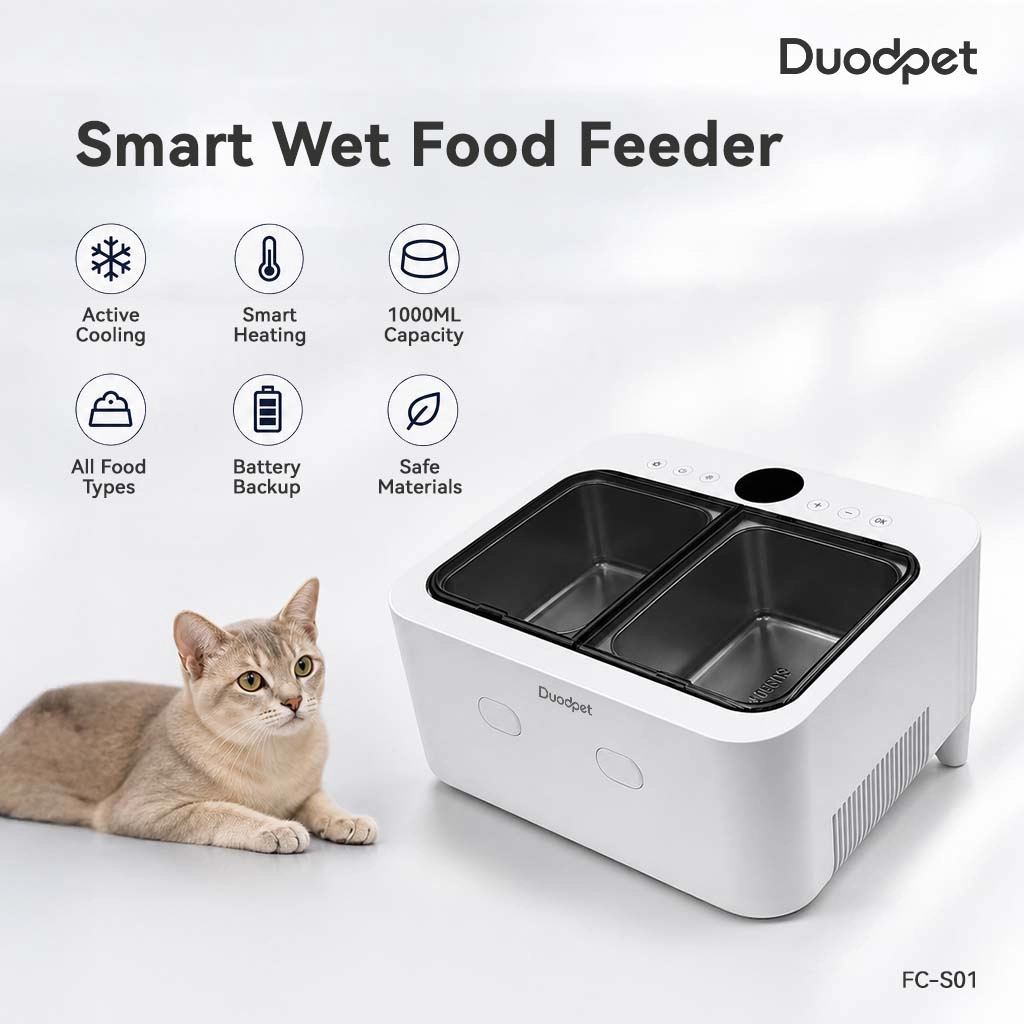
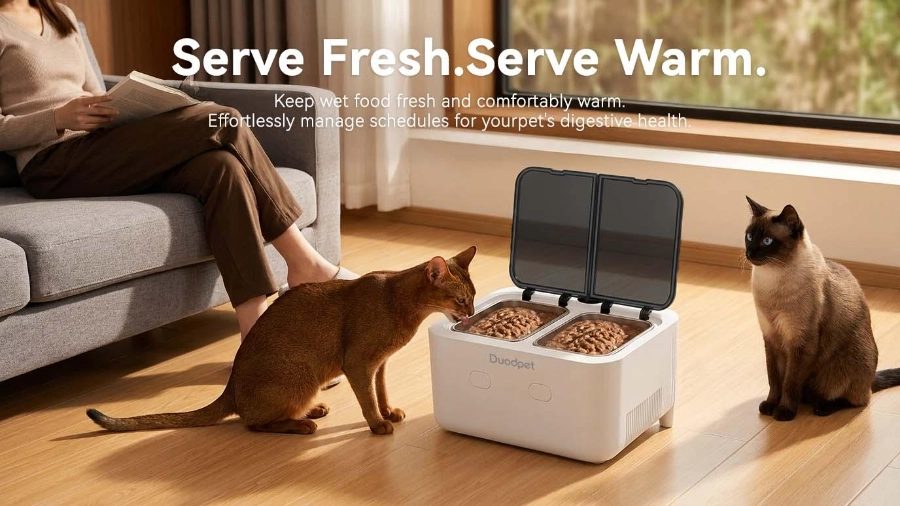
For a U.S. pet retailer, the first question is fit. Does the feeder support existing wet-food routines, or introduce a complicated care story? The DUODPET FC-S01 combines active semiconductor cooling, scheduled pre-heating, two food chambers, local controls, and removable stainless steel bowls.
How Should a Wet Food Cat Feeder Fit the Use Case?
Wet food shoppers may ask for scheduled meals, cooler storage, or a warmer serving temperature. Describe the product around functions it actually provides. The FC-S01 lists active semiconductor cooling and smart pre-heating to approximately 95°F before serving, without promising a universal food-safety interval or medical outcome.
The DUODPET FC-S01 wet food feeder should be tested with the food formats customers buy. Check whether bowls, lids, and meal timing are easy to explain, and distinguish the model from a conventional dry feeder.
Verify Capacity and Chamber Logic for a Wet Food Cat Feeder
The FC-S01 is specified with 1,000 mL total capacity and two 500 mL bowls. A buyer should not stop at the headline number. Load each chamber with a representative portion, close the lids, and run the schedule. Observe whether the controls make it obvious which chamber opens for which meal and whether the bowl can be removed without disturbing the second serving.
The wide-mouth, tilted bowl is a visible merchandising detail that helps explain placement. Keep the description factual: the sample has a tilted opening; it does not prove every pet will prefer the posture.
Check Cooling and Pre-Heating Claims on the Sample
Cooling is what separates a wet food cat feeder from most dry-food models. Ask for the cooling surface, operating conditions, and loading instructions. Run a receiving test that records the meal time, display response, and transition from cooling to pre-heating. For a wet food cat feeder, that sequence is more useful than a generic feature claim.
The FC-S01 states that pre-heating begins 30 minutes before a scheduled meal and targets approximately 95°F. Keep that language model-specific rather than a guarantee for every recipe, room, or portion. Review refrigerated wet-feeder guidance and ask what the customer sees when a cycle is interrupted.
Review Power, Controls, and Offline Operation
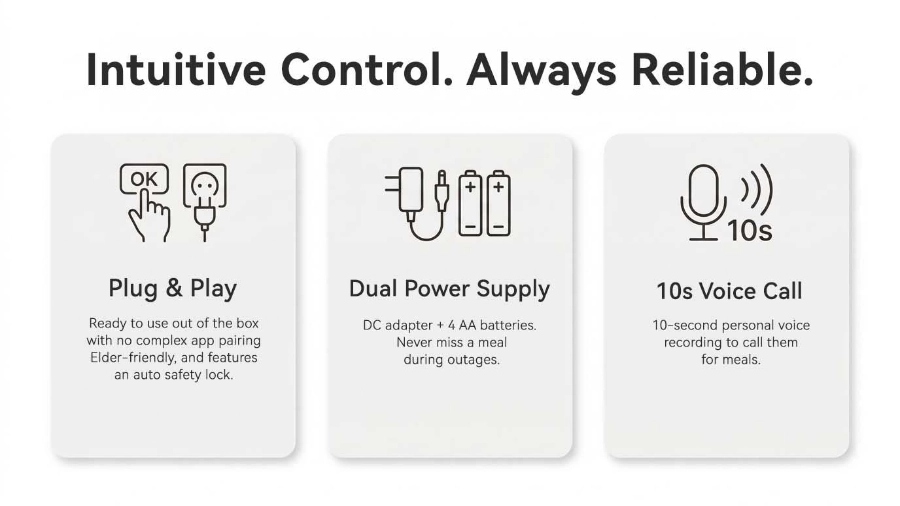
A feeder that needs a reliable schedule must have an understandable power plan. The FC-S01 uses a DC adapter and supports four AA batteries as backup. Test the approved transition and record schedule visibility, panel status, and battery replacement steps.
The local control panel avoids an app-pairing explanation and lets shoppers see the schedule on the unit. Demonstrate the safety lock and 10-second voice recording only if the instructions are clear. The DUODPET feeding range helps place this model beside dry-food and fresh-food products without treating them as interchangeable.
Inspect Bowls, Lids, and Cleaning Boundaries
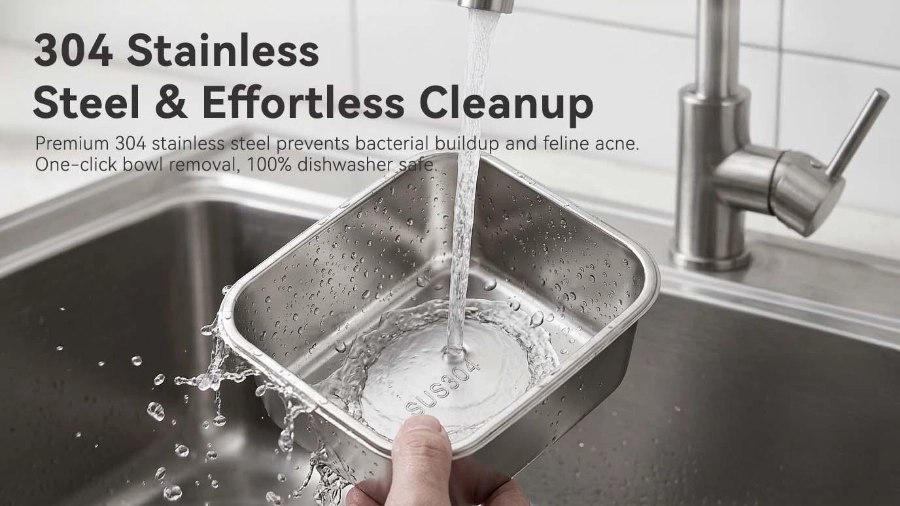
Wet food creates a more demanding cleaning conversation than dry kibble. Remove both bowls, open the lids, and inspect food-contact edges. The FC-S01 materials identify stainless steel bowls, one-click removal, and dishwasher-safe cleaning; read the manual to confirm what may be washed.
Ask a new staff member to reassemble the feeder without coaching. If bowl orientation, lid closure, or cleaning boundaries are unclear, confirm them with DUODPET support before ordering.
Test Fit, Noise, and Counter Presentation for a Wet Food Cat Feeder
Physical fit matters on a retail counter. The FC-S01 lists dimensions of 263 × 223 × 129 mm and a net weight of 2 kg. Measure the sample with lids open, leave room for power, and check bowl visibility from the shopper's side.
The listed working noise is under 50 dBA. Treat that as a specification to verify, not a promise that every room will sound the same. Run cooling and opening cycles in the display area and note whether sounds are acceptable beside other products.
Confirm Support Before You Stock It
The strongest sample test ends with a support test. Request the current manual, carton artwork, market voltage information, battery guidance, warranty terms, and replacement routes for bowls and lids. Match the model name across product, instructions, and reorder documents.
Retailers can use the DUODPET distributor program to discuss resources and technical support when assessing supplier fit. The DUODPET contact team can confirm current commercial details. A wet food cat feeder needs support documentation as much as a clear display. Keep shelf copy narrower than the full feature list: explain what shoppers can see, what the manual supports, and what the store can service.
Make the Decision With a Repeatable Receiving Test
The best wet food cat feeder is the one a retailer can demonstrate and support consistently. Run the same receiving sequence for every sample: load both bowls, program meals, observe cooling and pre-heating, simulate the approved power transition, open the safety lock, remove bowls, and restore the unit. Record any step requiring specialist knowledge.
That record turns a feature sheet into an assortment decision. If the food path, controls, cleaning routine, and support route are clear, staff can sell it with confidence. Resolve any vague point before the feeder reaches a customer's home.
FAQs
Q: What is the difference between a wet food cat feeder and a dry feeder?
A: A wet food cat feeder is designed around prepared meals, food-contact bowls, and a storage or serving routine that may include cooling and pre-heating. A dry feeder normally focuses on a hopper and portion release. Buyers should verify the exact food types, chamber design, and care instructions for the model they stock.
Q: Should retailers test cooling and heating before ordering?
A: Yes. Run the sample through its documented cycle and record what the display, lids, and bowls do at each stage. Keep the temperature language tied to the supplier's specification, and do not turn one test into a universal food-safety or health claim.
Q: What support should a buyer request for a wet food cat feeder?
A: Request the current manual, electrical details, approved market information, warranty terms, cleaning boundaries, spare-bowl and lid references, packaging files, and a reorder contact. Those documents keep staff explanations and customer support aligned with the model actually shipped.