At first glance, an automatic cat feeder for wet and dry food looks like a tidy one-SKU answer. The phrase actually covers two quite different jobs. Kibble can drop from a hopper, while a wet meal normally sits in a prepared bowl until serving time. The sale starts with the customer’s meal routine, not the feature panel.
Why “Wet and Dry” Is an Architecture Question
Look at the route from storage to bowl. Loose pieces fall through a hopper outlet. A tray uncovers food that the owner measured in advance. Cooled models keep that prepared meal in the chamber where it will be served. As a result, storage volume, serving method, and cleanup depend on the route the food takes.
Store staff can make the choice much easier by asking about the next day of meals. A customer planning six small kibble servings is shopping for a different machine from someone preparing two soft meals before work. Once that routine is clear, app controls, cameras, and voice features have a useful context.
What Does a Dry-Food Hopper Do Well?
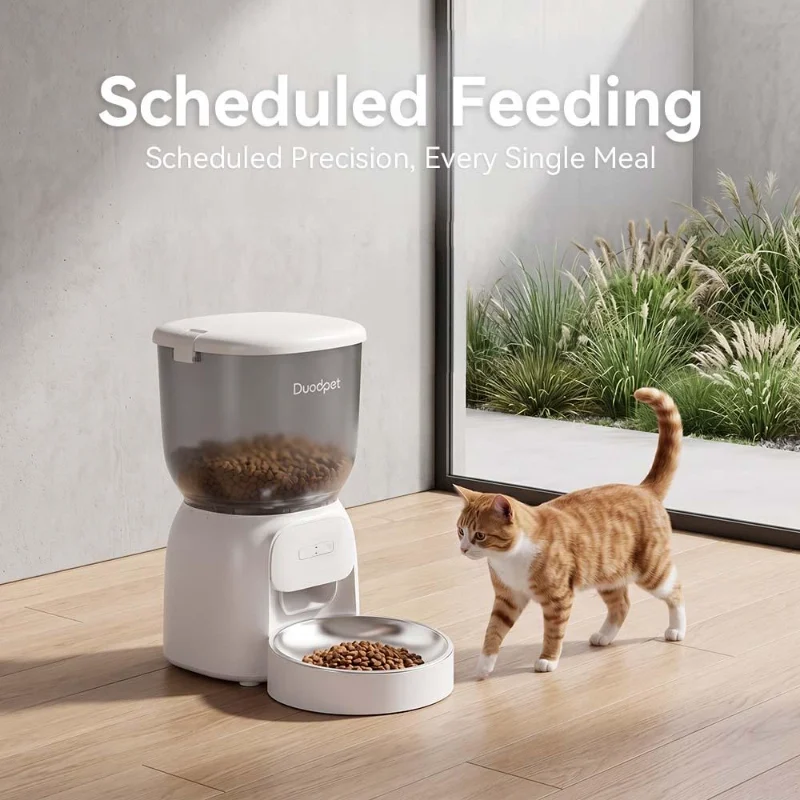
A dry-food hopper is designed to store compatible pieces and release a set portion on schedule. The DUODPET F01-W timed feeder has a 4 L hopper and is specified for dry pet food measuring 3–12 mm. It supports one to six meals daily, with one to fifteen portions per meal at approximately 10 g ±2 g per serving.
On the shop floor, those figures are enough for a clean demonstration. Fill the hopper with kibble that sits inside the stated range, program a meal, and collect several servings on a scale. Record the food and portion setting beside the results. That small note matters because a round pellet and an irregular piece may not travel through the outlet in exactly the same way.
Moist food changes the job completely. It can smear against a channel designed for separate pieces, and it brings a different cleanup routine with it. When the current manual limits a hopper to dry food, the product description needs to say the same thing. “Automatic” does not make the food path universal.
How Does a Wet-Food Chamber Change the Decision?
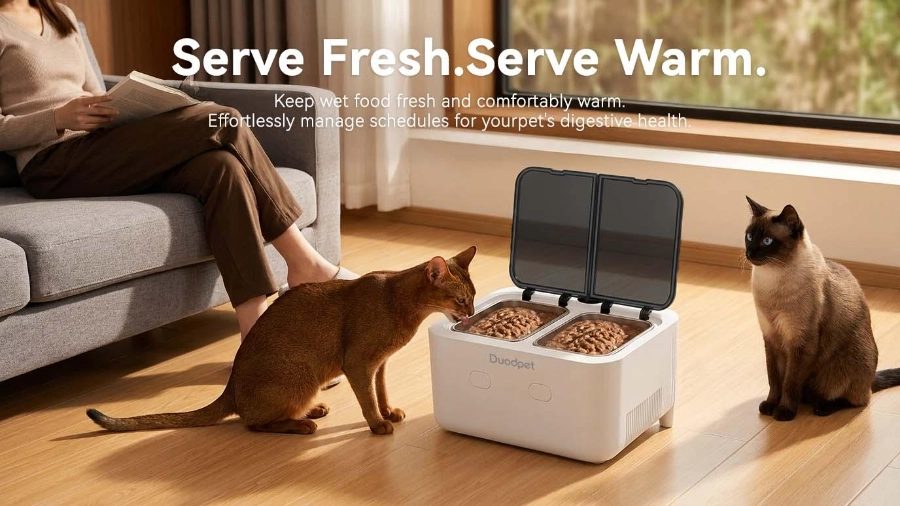
With a chamber feeder, the portions go in before the customer leaves home. Two 500 mL stainless-steel bowls sit inside the DUODPET FC-S01 wet food feeder, for 1,000 mL altogether. The two meal times are set on the unit itself. DUODPET also lists semiconductor cooling and pre-heating toward 95°F before serving.
Most of the work happens up front. The owner fills both bowls and sets their times, then washes the food-contact parts after the meals. Package directions and the feeder manual still apply, even when the unit cools and warms food. Avoid a fixed holding-time promise unless the current instructions support it for the food and conditions being discussed.
Dry pieces may fit in a chamber when the manufacturer allows them, but the bowl is still a bowl. It does not become a 4 L supply. Someone who needs several small kibble servings will usually get more value from a hopper. A buyer preparing wet portions has a stronger reason to begin with the chamber format.
Can One Automatic Cat Feeder for Wet and Dry Food Replace Two Types?
Sometimes, but the store needs evidence for the exact model. A compartment-style feeder may accept wet and dry portions when its instructions say so. It still will not behave like a 4 L hopper. Likewise, a hopper may deliver days of compatible kibble, but it should not be stretched into a wet-food claim.
For most retail assortments, the clearer answer is two distinct positions. The DUODPET feeding range lets buyers compare models around the customer’s actual meal routine. One position can explain bulk dry-food scheduling; another can explain prepared wet-food portions. Clear separation reduces the risk that “wet and dry” is mistaken for unlimited compatibility.
How Should Retailers Compare Wet and Dry Feeders?
Start with the food path, then compare the operating burden. For dry food, confirm the stated piece-size range, portion settings, outlet behavior, and cleaning boundary. For wet food, confirm bowl capacity, chamber timing, temperature functions, removable parts, and the instructions that define safe use. Power backup also needs model-specific wording because it may preserve scheduling without preserving every connected feature.
Keep the shelf card focused on the choice the shopper must make. App-based dry-food scheduling answers one routine; two prepared wet meals answer another. Separate cards will usually explain those jobs more clearly than a combined list. The wet food cat feeder evaluation guide gives the team a deeper receiving and care check for the chamber category.
What Can a Store Learn From One Sample?
Test the points that will appear on the listing. Run the dry hopper with the kibble planned for the display, then keep the selected setting beside the measured portions. On the chamber unit, load the intended meal, program both times, watch the lids, and remove the parts a customer will wash.
Write down the model number and manual version alongside the power setup, included accessories, and package wording. If the quotation describes something different, pause photography and listing work until the two match. Through DUODPET distributor support, trade buyers can coordinate the sample, media files, customization scope, and after-sales plan for the intended order.
FAQs
Q: Can a dry automatic cat feeder hold wet food?
A: If the manual says “dry food only,” stay inside that limit. Hopper outlets are built for separate pieces within a stated size range. Moist food will not move or clean up in the same way. Check the instructions for the exact model instead of relying on the word “automatic.”
Q: What if dry food goes into a dual-chamber feeder?
A: Start with the manufacturer’s approved food formats. If dry pieces are allowed, they will sit in prefilled bowls rather than a bulk supply. That may suit one or two planned meals. It will not offer the same capacity or serving pattern as a hopper.
Q: Is one feeder SKU enough for both meal types?
A: One SKU is enough only when its current instructions allow both foods and its portion capacity fits the shopper’s routine. Otherwise, a dry hopper beside a wet-food chamber gives staff a simpler explanation and customers a clearer choice.
22nd October 2026